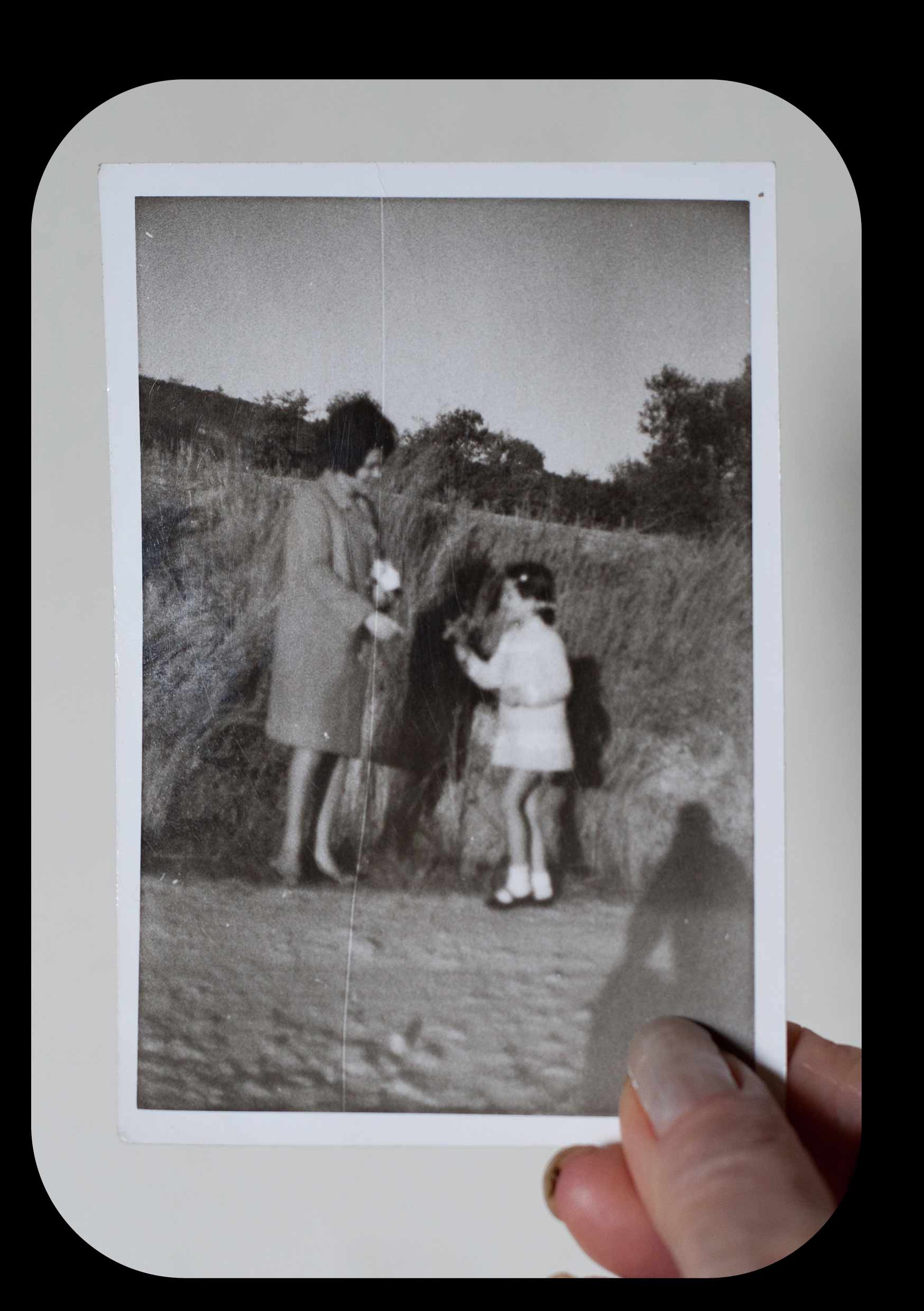
paula e mãe, em trabalho de campo entre plantas, fotografadas pelo pai da artista. arquivo familiar, s.d.
paula and mother, engaged in fieldwork among plants, photographed by the artist’s father. family archive, n.d.
A PRÁTICA ARTÍSTICA COMO INFRAESTRUTURA
01 — POSIÇÃO
Como me posiciono enquanto artista, investigadora, editora e produtora das minhas próprias estruturas.
02 — TRABALHAR INFRAESTRUTURALMENTE
A prática não apenas como produção de obras, mas como construção das condições que permitem que obras, relações, publicações, arquivos e encontros existam.
03 — ECONOMIA DA VIDA
A questão do trabalho, do tempo, da sustentabilidade, do cuidado e da autonomia: como organizar uma prática artística dentro da vida.
04 — PEDAGOGIAS INVISÍVEIS
As formas de atenção, aprendizagem e transmissão que antecedem a prática e continuam a estruturá-la.
ARTISTIC PRACTICE AS INFRASTRUCTURE
01 — POSITION
How I position myself as an artist, researcher, publisher and producer of my own structures.
02 — WORKING INFRASTRUCTURALLY
Practice not simply as the production of works, but as the construction of the conditions through which works, relationships, publications, archives and encounters can exist.
03 — ECONOMY OF LIFE
Questions of labour, time, sustainability, care and autonomy: how to organise an artistic practice within life.
04 — INVISIBLE PEDAGOGIES
Forms of attention, learning and transmission that precede the practice and continue to structure it.
01 — POSITION / POSIÇÃO
Escrevo isto não como uma biografia retirada de outro lugar, mas a partir de dentro de uma prática moldada por trabalho continuado, decisões, recusas e continuidades.
A minha prática não é organizada em torno de meios, mas das relações e condições que os tornam possíveis. Fotografia, publicação, instalação, arquivo, trabalho de campo, processos participativos e computacionais não constituem disciplinas separadas: são formas que uma investigação pode assumir à medida que atravessa diferentes situações, materiais e infraestruturas.
Trabalho através da msdm — mobile strategies of display & mediation — não apenas como plataforma editorial, mas como uma estrutura que me permite produzir as próprias condições da prática. Publicar pode significar fazer um livro, construir uma exposição, organizar uma mesa, caminhar, trabalhar com um arquivo, criar uma plataforma digital ou desenvolver um processo colectivo.
Metodologicamente, trabalho a partir de investigação situada, pensamento feminista e decolonial, tecnobiografia e autoetnografia, perspectivas pós-humanas e mais-que-humanas, e pedagogias lentas, relacionais e orientadas pelo cuidado.
O que me importa não é a estabilização de um estilo autoral, mas a manutenção de uma posição: uma recusa da optimização e da escala; um compromisso com o cuidado, a lentidão e a relação; uma compreensão das instituições como materiais e não como autoridades; e uma disponibilidade para permanecer na instabilidade em vez de a resolver.
Construo condições para pensar, fazer e publicar nas fissuras das instituições, sem procurar estabilizar essas fissuras em novas estruturas de poder.
01 — POSITION
I am writing this not as a biography extracted from elsewhere, but from within a practice shaped by sustained work, decisions, refusals and continuities.
My practice is not organised around media, but around the relationships and conditions that make them possible. Photography, publishing, installation, archives, fieldwork, participatory and computational processes are not separate disciplines: they are forms that an inquiry can take as it moves through different situations, materials and infrastructures.
I work through msdm — mobile strategies of display & mediation — not simply as a publishing platform, but as a structure through which I can produce the conditions of the practice itself. Publishing might mean making a book, constructing an exhibition, organising a table, walking, working with an archive, creating a digital platform or developing a collective process.
Methodologically, I work through situated research, feminist and decolonial thought, technobiography and autoethnography, posthuman and more-than-human perspectives, and slow, relational and care-oriented pedagogies.
What matters to me is not the stabilisation of an authorial style, but the maintenance of a position: a refusal of optimisation and scale; a commitment to care, slowness and relation; an understanding of institutions as materials rather than authorities; and a willingness to remain within instability rather than resolve it.
I build conditions for thinking, making and publishing within the cracks of institutions, without seeking to stabilise those cracks into new structures of power.
02 — TRABALHAR INFRAESTRUTURALMENTE
Trabalhar infraestruturalmente significa começar pelas condições: pela forma como as coisas são organizadas, sustentadas, circuladas e mantidas. Interessa-me menos aquilo que uma imagem, um livro ou um projecto é, e mais aquilo que o torna possível, aquilo de que depende e quem — ou o quê — o mantém em funcionamento.
Trato imagens, livros, plataformas, workshops e instituições no mesmo plano. Nenhum destes é apenas um resultado ou um contexto para mim. São materiais. Trabalho com eles, com o seu peso e as suas restrições, e presto atenção à forma como moldam relações, tempo e trabalho. Uma imagem pode funcionar como uma infraestrutura; um workshop pode tornar-se um espaço de publicação; uma plataforma pode agir como arquivo; uma instituição pode ser temporariamente reconfigurada como um lugar de cuidado ou experimentação.
Trabalhar de forma infraestrutural significa reorganizar o que já existe, em vez de inventar do zero. Significa permanecer próximo dos sistemas, tocá-los, aprender os seus limites e intervir a partir de dentro. Por vezes isso implica reconfiguração — dobrar formatos, abrandar processos, deslocar papéis. Outras vezes implica resistência: recusar a legibilidade, retirar-se da lógica da otimização ou desalinharmo-nos das expectativas de eficiência e escala.
Esta forma de trabalhar não vem apenas da teoria. Vem da experiência — de circular entre contextos artísticos, editoriais, pedagógicos e institucionais, e de atravessar tanto os seus fracassos como as suas possibilidades. Para mim, pensar e fazer acontecem dentro destes sistemas, e não fora deles. A minha prática opera aí, na tensão entre uso e recusa, cuidado e exaustão, continuidade e rutura.
É isso que quero dizer quando digo que a minha prática é infraestrutural. Não se trata de dominar meios ou produzir formas estáveis, mas de trabalhar sobre as condições que moldam a organização do trabalho, do conhecimento e das vidas — e de encontrar formas de manter essas condições abertas, relacionais e responsáveis
02 — WORKING INFRASTRUCTURALLY
Working infrastructurally means beginning with conditions: with how things are organised, supported, circulated and sustained. I am interested less in what an image, a book or a project is, and more in what makes it possible, what it depends upon, and who — or what — keeps it in operation.
I treat images, books, platforms, workshops, and institutions on the same plane. None of these are just outputs or contexts for me. They are materials. I handle them, work with their weight and constraints, and pay attention to how they shape relations, time, and labour. An image can function like an infrastructure; a workshop can become a publishing space; a platform can act as an archive; an institution can be temporarily reconfigured as a site of care or experimentation.
Working infrastructurally means rearranging what already exists rather than inventing from scratch. It means staying close to systems, touching them, learning their limits, and intervening from within. Sometimes that involves reconfiguration — bending formats, slowing processes down, shifting roles. At other times it involves resistance: refusing legibility, withdrawing from optimisation, or misaligning myself from expectations of efficiency and scale.
This way of working doesn’t come from theory alone. It comes from experience — from moving between artistic, editorial, pedagogical, and institutional contexts, and from living through their failures as much as their possibilities. Thinking and making happen for me inside these systems, not outside them. My practice operates there, in the tension between use and refusal, care and exhaustion, continuity and breakdown.
That’s what I mean when I say my practice is infrastructural. It’s not about mastering media or producing stable forms, but about working on the conditions that shape how work, knowledge, and lives are organised — and finding ways to keep those conditions open, relational, and accountable.
03 — ECONOMIA DA VIDA
Se trabalhar infraestruturalmente significa prestar atenção às condições que tornam uma prática possível, então essas condições incluem necessariamente a própria vida.
A Economia da Vida parte desta relação entre trabalho, tempo, cuidado, autonomia e continuidade. A msdm funciona parcialmente através de uma ecologia da dádiva, reconhecendo que nem todas as formas de valor podem ser medidas através de modelos convencionais de trabalho, produtividade ou transacção económica.
Muitos dos meus projectos emergem através de colaborações, amizades, redes informais de apoio e processos de aprendizagem partilhada. A Economia da Vida procura criar espaço para formas de reciprocidade que valorizem não apenas resultados, mas também processos, relações e as condições que tornam possível continuar a investigar, criar, partilhar e cuidar.
Trata-se também de tornar visível uma realidade frequentemente apagada no trabalho artístico e de investigação: uma prática acontece dentro de uma vida. Requer tempo, recursos, descanso, cuidado, relações e formas de sustentabilidade que não podem permanecer indefinidamente fora daquilo que entendemos como trabalho.
03 — ECONOMY OF LIFE
If working infrastructurally means paying attention to the conditions that make a practice possible, then those conditions necessarily include life itself.
The Economy of Life begins from this relationship between labour, time, care, autonomy and continuity. msdm operates in part through a gift ecology, recognising that not all forms of value can be measured through conventional models of labour, productivity or economic exchange.
Many of my projects emerge through collaborations, friendships, informal networks of support and processes of shared learning. The Economy of Life seeks to create space for forms of reciprocity that value not only outcomes, but also processes, relationships and the conditions that make it possible to continue researching, creating, sharing and caring.
It is also about making visible a reality that is often erased within artistic and research practice: a practice takes place within a life. It requires time, resources, rest, care, relationships and forms of sustainability that cannot remain indefinitely outside what we understand as work.
04 — Pedagogias Invisíveis
Antes de a infraestrutura se tornar uma escolha consciente, algumas das suas condições já estavam presentes.
Há uma aprendizagem que vem de muito antes de ter nome, uma espécie de pedagogia invisível que passa pelo gesto, pelo olhar, pela forma de estar.
Esta imagem regressa como um dispositivo de leitura do que sempre esteve a formar-se antes de eu saber que estava a aprender.
Vejo-me com a minha mãe, entre plantas, num gesto que hoje reconheço como uma prática de atenção — uma disponibilidade do corpo para o que cresce, para o que respira ao nosso lado, para o que não exige centralidade humana para existir. Não é ainda uma metodologia, não é ainda investigação, mas já é uma forma de conhecimento.
Foi o meu pai que fez a fotografia. Ele está presente na imagem como sombra, no canto inferior, quase fora do enquadramento. Essa presença oblíqua torna-se agora reveladora: não apenas aquele que regista, mas aquele que sustém a cena, que cria as condições para que ela aconteça e permaneça.
Há uma transmissão aqui que não é linear nem discursiva. Passa entre corpos, entre tempos, entre gestos aparentemente simples. Uma aprendizagem que não se fixa, mas infiltra — como a água, como a luz, como a própria imagem.
Olhando para esta fotografia hoje, percebo que muito do que estrutura a minha prática — o trabalho com plantas, com arquivos vernaculares, com formas de atenção mais lentas e relacionais — já estava a ser ensaiado neste encontro. Não como intenção, mas como condição.
Eles ensinaram-me sem declarar ensino. Ofereceram-me uma forma de estar no mundo onde imagem, corpo e ecologia não se separam.
04 — Invisible Pedagogies
Before infrastructure became a conscious choice, some of its conditions were already present.
There is a form of learning that comes from long before it has a name, a kind of invisible pedagogy that moves through gesture, through looking, through ways of being.
This image returns as a device for reading what was already forming before I knew I was learning.
I see myself with my mother, among plants, in a gesture that I now recognise as a practice of attention — a bodily openness to what grows, to what breathes alongside us, to what does not require human centrality in order to exist. It is not yet a methodology, not yet research, but it is already a form of knowledge.
It was my father who took the photograph. He is present in the image as a shadow, in the lower corner, almost outside the frame. This oblique presence now becomes revealing: not only the one who records, but the one who holds the scene, who creates the conditions for it to happen and to endure.
There is a transmission here that is neither linear nor discursive. It moves between bodies, between times, between seemingly simple gestures. A form of learning that does not fix itself, but seeps in — like water, like light, like the image itself.
Looking at this photograph now, I realise that much of what structures my practice — the work with plants, with vernacular archives, with slower and more relational forms of attention — was already being rehearsed in this encounter. Not as intention, but as condition.
They taught me without declaring teaching. They offered me a way of being in the world in which image, body and ecology are not separate.