
Terrain Vague Ecologies
Computational Readings of Ignasi de Solà-Morales' Terrain Vague
Hey there, this is the default text for a new paragraph. Feel free to edit this paragraph by clicking on the yellow edit icon. After you are done just click on the yellow checkmark button on the top right. Have Fun!
Project and editorial design: paula roush
Pages: 16
Language: English
Format: folded publication
(A4 → A5, 16-page booklet)
First edition: July 2026
Published by: msdm publications
Ebook available for free download via payhip:
download PDF
Thirty years after Terrain Vague, where has vacancy migrated?
Terrain Vague Ecologies is an experimental editorial publication that revisits Ignasi de Solà-Morales' seminal essay Terrain Vague,thirty years after its publication.
The publication approaches the essay as a conceptual landscape whose internal ecologies can be explored through computational reading.
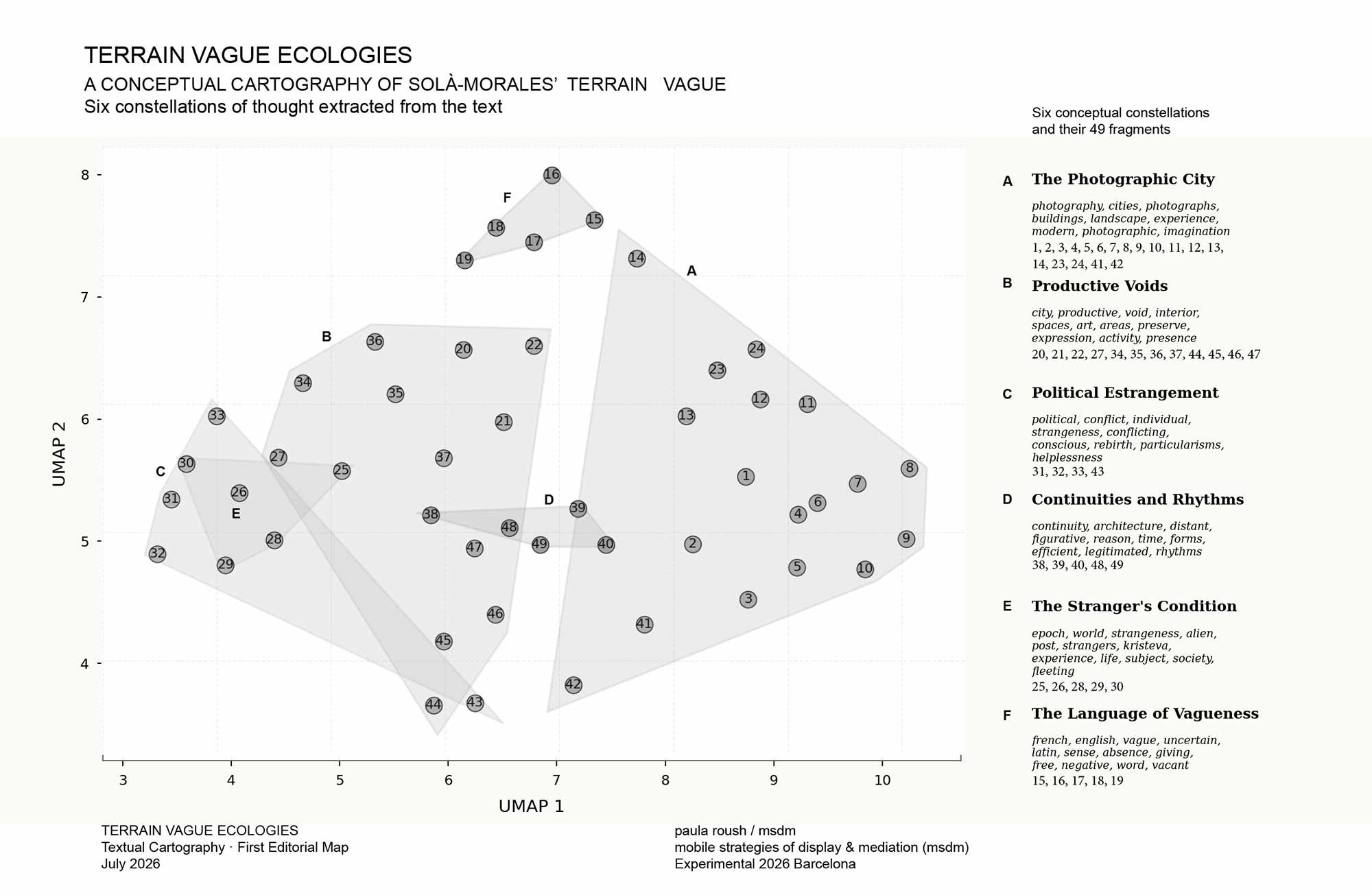
The essay was segmented into forty-nine editorial fragments. Each fragment was transformed into a semantic embedding and analysed using computational language models, UMAP dimensional reduction and editorial mapping.
The resulting semantic relationships were interpreted as six conceptual constellations, producing a navigable atlas that proposes an alternative way of reading Terrain Vague.
Thirty years later, the question shifts from defining terrain vague to tracing where vacancy has migrated in the contemporary city. Computational reading becomes both method and medium, revealing latent conceptual relationships within philosophical writing while generating new cartographies of thought.
Designed as both a publication and a field companion, Terrain Vague Ecologies is intended to accompany future walking, photographic and editorial investigations without prescribing them. It functions as a conceptual guide that can be carried into the field, where its semantic constellations become prompts for observation, discussion and image-making.
Here, computational methods function as forms of close reading, revealing latent conceptual relationships within philosophical writing while opening new possibilities for artistic publishing and editorial research.
This digital edition is distributed freely as part of msdm publications' commitment to open circulation, artistic research and experimental publishing.